
A lease acquisition fee is a one-time payment made by renewable energy developers to property owners at the beginning of a land lease agreement, typically for wind or solar projects. This upfront payment compensates landowners for the time, disruption, and opportunity cost associated with entering into a long-term lease arrangement, separate from ongoing annual rental payments or revenue sharing that follows once the project becomes operational.
For property owners considering participation in clean energy development, understanding this fee structure is essential to evaluating the full financial picture of a lease agreement. Acquisition fees typically range from a few thousand dollars to significantly higher amounts per acre, depending on project type, location, land quality, and the developer’s assessment of the site’s energy production potential. Unlike annual lease payments that may be tied to project performance or energy output, the acquisition fee provides immediate, guaranteed compensation regardless of whether the project ultimately moves forward to construction.
This article breaks down how lease acquisition fees work within renewable energy agreements, explores the different structures developers use, and provides practical guidance for property owners evaluating offers. As renewable energy development continues to expand across rural and agricultural landscapes, transparent communication about these financial components strengthens the partnerships between developers and landowners that make clean energy projects possible. Whether you’re reviewing your first solar lease proposal or managing multiple energy agreements across your property, a clear understanding of acquisition fees helps you make informed decisions that align with both your financial goals and your commitment to supporting sustainable energy infrastructure.
What Is a Lease Acquisition Fee?
A lease acquisition fee is a one-time payment made to property owners at the outset of a renewable energy lease agreement, compensating them for granting developers site control and exclusivity rights for wind or solar project development. Unlike ongoing lease payments or royalties that property owners receive throughout a project’s operational life, the acquisition fee is paid early in the development process, typically when the lease is signed or when specific initial milestones are met.
This upfront payment serves multiple purposes in renewable energy development. It rewards landowners for committing their property to a long-term lease relationship, often spanning 30 to 50 years. It also provides immediate financial benefit while developers conduct feasibility studies, secure permits, and arrange financing, activities that can take several years before construction begins and regular lease payments commence.
- Acquisition Fee
- A one-time payment made to property owners when entering into a renewable energy lease agreement, compensating them for granting site control and development rights.
- Lease Execution Payment
- The portion of an acquisition fee paid when the lease contract is formally signed, establishing the legal relationship between property owner and developer.
- Signing Bonus
- An industry term for upfront payments given to landowners as consideration for agreeing to lease terms, similar to acquisition fees in renewable energy contexts.
- Initial Consideration
- The legal term for any payment or value exchanged at the beginning of a lease agreement to make the contract binding and compensate the property owner for entering into the arrangement.
Lease acquisition fees are standard practice in both wind and solar development, though the specific amounts and payment structures vary. In wind projects, fees might account for larger land areas needed for turbine spacing and access roads. Solar projects, which require contiguous parcels with suitable terrain and sun exposure, may structure fees differently based on the developable acreage.
The distinction between acquisition fees and ongoing lease payments is important for property owners to understand. While the acquisition fee provides immediate compensation, it represents only the initial phase of what should be a mutually beneficial long-term partnership between landowners and renewable energy developers committed to advancing clean energy infrastructure.

How Lease Acquisition Fees Work

When Fees Are Paid
Lease acquisition fees typically become payable at specific trigger points in the project development timeline rather than at a single predetermined date. The most common payment trigger is the execution of the lease agreement itself, once both the property owner and developer sign the contract, the fee is disbursed within a specified period, often 30 to 90 days.
Many lease agreements structure acquisition fees as conditional payments tied to development milestones. A portion might be paid upon signing, with additional payments released when the developer secures necessary permits, completes environmental studies, or reaches financial close on the project. This staged approach protects both parties: property owners receive compensation as the project advances, while developers tie payments to tangible progress.
In some cases, the full acquisition fee is held until construction begins. This ensures the developer has achieved all regulatory approvals and financing commitments before the property owner receives payment. The lease agreement will specify exact payment triggers, timelines, and any conditions that must be satisfied. Property owners should review these terms carefully to understand when they can expect to receive their acquisition fee and what milestones govern each payment.
Factors That Influence Fee Amounts
The acquisition fee a property owner can expect varies significantly based on several interconnected factors that developers evaluate during the site assessment process.
Property size stands as a primary determinant. Larger parcels generally command higher absolute fees, though the per-acre rate may decrease as acreage increases. A 100-acre site suitable for wind turbines will typically receive a substantially different fee than a 10-acre solar-ready parcel.
Resource quality directly impacts fee calculations. Properties with exceptional wind speeds at hub height or optimal solar irradiance measurements justify premium acquisition payments because they promise higher energy production and project returns. Developers conduct thorough resource assessments before finalizing fee offers, and sites with superior renewable energy potential consistently receive more competitive compensation.
Proximity to existing transmission infrastructure significantly affects fee structures. Land located near substations or high-voltage transmission lines reduces project interconnection costs and development risk, making these properties more valuable to developers and warranting higher acquisition fees.
Land use restrictions and zoning considerations also shape fee amounts. Properties with clear titles, minimal encumbrances, and favorable zoning for renewable energy development command higher fees than those requiring complex permitting processes or easement negotiations.
Market conditions in 2026 play an essential role. Regional competition for quality sites, current energy prices, renewable energy incentives, and local landowner participation rates all influence what developers can offer while maintaining project viability.
Types and Components of Lease Acquisition Fees
Upfront vs. Conditional Fees
Lease acquisition fees typically fall into two broad categories based on payment timing. Upfront fees are paid when the lease agreement is executed, providing immediate compensation to property owners for granting site control and development rights. These fees offer certainty and immediate value, though they may be smaller in amount since they carry no performance contingencies.
Conditional fees, by contrast, are tied to specific project milestones. Payment might occur when environmental studies are completed, when permits are secured, or when construction begins. This structure protects developers from paying for sites that don’t advance to operational status while potentially offering landowners larger fees if the project succeeds. Some agreements blend both approaches, providing a modest upfront payment with additional conditional payments at critical development stages.
In 2026’s renewable energy market, conditional structures have become more common for complex projects facing regulatory uncertainty. Property owners working with experienced developers can negotiate terms that balance immediate compensation with performance-based incentives, creating partnerships that align interests throughout the development timeline. The right structure depends on risk tolerance, project characteristics, and both parties’ priorities.
Why Lease Acquisition Fees Matter in Renewable Energy Development
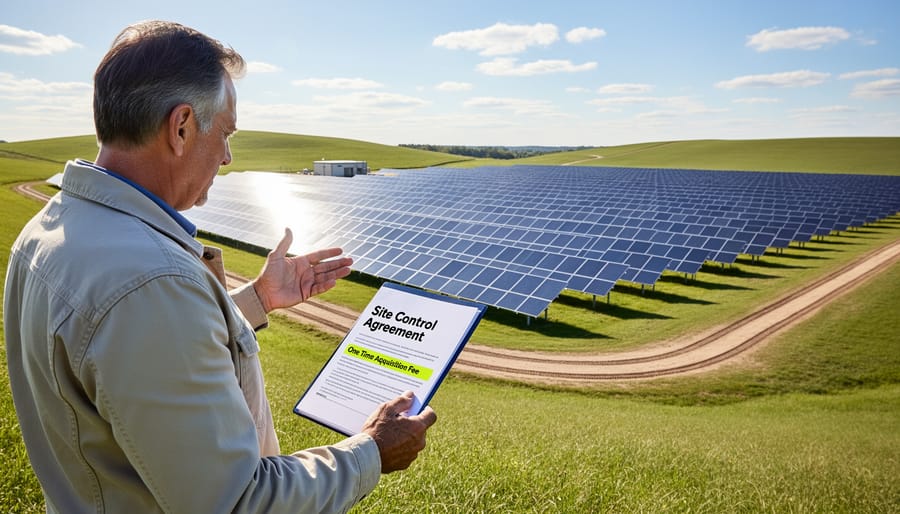
Lease acquisition fees serve a critical dual purpose in renewable energy development, creating immediate value for property owners while giving developers the time and site control necessary to advance complex clean energy projects. For landowners, these fees represent tangible compensation for granting exclusive rights to a developer who will spend months or even years conducting resource assessments, securing permits, and navigating regulatory approvals before a single turbine or solar panel is installed. This upfront payment acknowledges the real commitment property owners make when they enter into these agreements.
From a developer’s perspective, acquisition fees secure the site control essential for moving forward with multi-million dollar investments in project planning and permitting. Without locked-in land rights, no developer can justify the substantial costs of wind studies, environmental assessments, transmission analyses, or engineering work. The fee essentially purchases the exclusivity needed to perform due diligence and build the business case for a project that may take three to five years to reach construction.
These fees also establish the foundation for long-term partnerships between developers and landowners. A fair acquisition fee signals a developer’s seriousness and financial commitment to the project while demonstrating respect for the property owner’s role in advancing clean energy infrastructure. This initial financial exchange often sets the tone for decades of collaboration, as successful wind and solar projects typically operate for 25 to 35 years.
The fees accelerate renewable energy deployment by reducing barriers to entry for property owners who might otherwise hesitate to commit land for unproven projects. By offering concrete financial benefits at the outset rather than only future royalties, acquisition fees make participation more accessible and attractive, expanding the pool of available sites for development. This broader land base ultimately supports faster buildout of the clean energy capacity needed to replace conventional energy sources and meet climate goals.
Common Uses of Lease Acquisition Fees
Lease acquisition fees serve several critical functions in renewable energy project development, benefiting both property owners and developers as projects move from initial concept to operational reality. Understanding these practical applications helps landowners recognize why these fees represent more than just early compensation, they’re an essential tool for advancing clean energy infrastructure while protecting stakeholder interests.
From a property owner’s perspective, acquisition fees provide tangible compensation for the immediate value and opportunity you’re granting to a developer. When you sign a lease agreement, you’re giving the developer exclusive rights to assess, develop, and potentially build a wind or solar facility on your land. This exclusivity means you can’t lease the same property to competing developers during the agreement period, even if other opportunities arise. The acquisition fee compensates you for this commitment and the restrictions you’re accepting.
The primary uses of lease acquisition fees include:
- Compensating landowners for granting exclusive site control and development rights
- Covering transaction costs including legal review, surveying, and due diligence expenses
- Establishing project exclusivity to protect the developer’s investment in feasibility studies
- Incentivizing early participation in renewable energy projects before construction certainty
- Offsetting any immediate land use restrictions or access requirements during assessment phases
- Building goodwill and demonstrating the developer’s commitment to fair partnerships
For developers, acquisition fees secure the time and access needed to conduct thorough site assessments, wind or solar resource studies, environmental reviews, and permitting work, activities that can span months or years before a final construction decision is made. These upfront payments demonstrate good faith and help establish the strong, trust-based relationships that are essential for successful long-term renewable energy projects. At Wind Unites Us, we view acquisition fees as an investment in our partnerships with property owners, reflecting our commitment to fair treatment and shared success in advancing clean energy solutions.
What Property Owners Should Know
If you’re a property owner considering a renewable energy lease, understanding acquisition fees is just the beginning. These initial payments set the tone for a long-term partnership, so approach negotiations with clear priorities and realistic expectations.
First, recognize that acquisition fees represent only one component of your total compensation. While a substantial upfront payment might seem attractive, evaluate how it balances with ongoing annual lease payments and production royalties that can span 25 to 40 years. A developer offering a modest acquisition fee but generous long-term terms may ultimately provide greater value than one front-loading compensation into the initial payment.
Tax implications deserve careful attention. Acquisition fees typically qualify as ordinary income in the year received, potentially creating a significant tax event. Consulting a tax advisor familiar with renewable energy transactions helps you plan appropriately and potentially structure payments across multiple tax years if the developer agrees.
Understand exactly what you’re granting in exchange for the fee. Most acquisition fee agreements include exclusivity provisions that prevent you from negotiating with competing developers for a specified period. Clarify the timeline, what happens if the project doesn’t advance, and whether any portion of the fee is refundable under specific circumstances.
The developer you choose matters as much as the financial terms. Experienced developers with strong track records maintain transparent communication throughout the development process, which can stretch several years from initial agreement to project operation. They understand that successful renewable energy projects depend on trust and mutual benefit, not just contractual obligations.
Before signing, request clarity on milestone triggers if your fee is conditional. Know precisely what events must occur before payment and the expected timeline. This prevents misunderstandings and ensures you’re entering the agreement with realistic expectations about when compensation will arrive.
Working with developers who prioritize long-term partnerships over transactional relationships creates the foundation for successful clean energy infrastructure that benefits your land, your community, and the broader transition to renewable power.
Frequently Asked Questions
Are lease acquisition fees refundable if the project doesn’t move forward?
In most cases, acquisition fees are non-refundable once paid, even if the project doesn’t reach construction. These fees compensate property owners for granting site control and exclusivity during the development phase, which involves real opportunity cost regardless of project outcome.
How do acquisition fees differ from ongoing lease payments?
Acquisition fees are one-time payments made at lease signing to secure site rights, while lease payments (or royalties) are recurring payments made throughout the operational life of the project, typically tied to energy production or revenue. Think of the acquisition fee as compensation for entering the agreement, whereas lease payments reward your ongoing participation in the project’s success.
What’s a typical range for lease acquisition fees in 2026?
Acquisition fees vary widely based on project type, property characteristics, and regional market conditions. Solar projects might offer $50 to $500 per acre, while wind projects could range from $500 to several thousand dollars per turbine site or affected acre, depending on resource quality and transmission access.
Can I negotiate the acquisition fee amount?
Yes, acquisition fees are negotiable. Factors like your property’s unique advantages, competing developer interest, and current market conditions all influence your negotiating position. Working with experienced developers who value long-term partnerships often leads to fair terms that reflect your land’s true value to the project.
Understanding these fundamentals helps property owners approach lease negotiations with realistic expectations. While acquisition fees represent immediate compensation, they’re just one component of the total value a renewable energy project brings to your property over its 20- to 30-year lifespan. The fee structure should align with your financial goals and risk tolerance, balancing upfront payment against the potential for substantial ongoing lease revenue once the project becomes operational.
Property owners should also recognize that acquisition fees serve a legitimate business purpose for developers. These payments secure exclusive rights during lengthy permitting and development periods that can span several years. During this time, you’re committed to the project, which means the fee compensates you fairly for that exclusivity and the developer’s investment in advancing the project through complex regulatory processes.
how it works
The lease acquisition fee process begins when a renewable energy developer identifies a property with strong wind or solar potential. After initial discussions with the property owner, both parties negotiate terms including the acquisition fee amount, payment conditions, and lease duration.
Once negotiations conclude and the property owner agrees to grant site control, the parties execute a formal lease agreement. The acquisition fee typically becomes payable at this stage, though some agreements tie payment to specific milestones like securing permits or completing environmental studies.
Payment methods vary by agreement structure. Flat fees are distributed as a single lump sum, while per-acre arrangements calculate the total based on the exact acreage committed to the project. Conditional fees may be released in phases as the developer achieves predetermined development benchmarks.
The developer uses this initial payment to compensate the landowner for exclusivity rights while conducting detailed site assessments, securing interconnection agreements, and advancing through permitting processes. The fee establishes the foundation for an ongoing partnership that continues throughout the project’s operational life, with regular lease payments commencing once construction begins.
Understanding lease acquisition fees empowers property owners to make informed decisions about participating in renewable energy development. These upfront payments represent more than a financial transaction, they’re the foundation of partnerships that drive clean energy forward. When structured fairly and transparently, acquisition fees compensate landowners for granting site control while enabling developers to secure the land access essential for wind and solar projects.
At Wind Unites Us, we recognize that strong relationships with property owners are central to successful renewable energy development. Our approach prioritizes clear communication, equitable terms, and long-term collaboration that benefits both landowners and the communities where we work. We’ve built our reputation on treating property owners as valued partners in the clean energy transition, not simply as transaction points.
As renewable energy infrastructure expands across the United States in 2026, the site acquisition process, and the acquisition fees that initiate it, will continue shaping how we power our future. Property owners who understand these fees can negotiate confidently and contribute meaningfully to projects that reduce reliance on conventional energy sources. By establishing fair agreements from the outset, we create the stable foundations needed for projects that will generate clean energy for decades to come.